
We bring you a transcript of an interview with Filip Brůna, who works for us as a BIM coordinator. The interview was published on the TZB-Info website.
Digital modeling in construction is not just a technological trend, but a necessity without which modern design will soon be unimaginable. BIM coordinator Filip Brůna from SAGASTA talks about the challenges and opportunities of working in a 3D environment and its digital transformation.
You work as a BIM coordinator. What does this position actually involve?
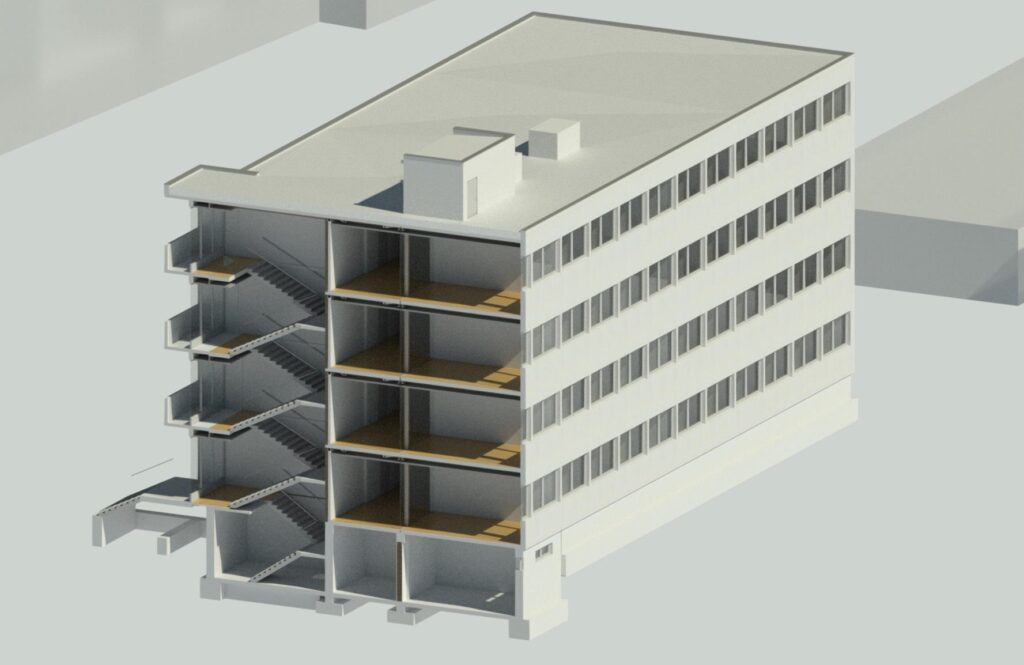
Imagine, for example, that a public contract is won, and we study the contract and the investor’s requirements in the company. This creates a kind of “shopping list” that describes what a specific model should contain and to what degree of detail. I supervise the model from the very beginning to the construction phase, but this model will also be functional after the construction is completed—for building management, maintenance, and the like. Thanks to the added metadata, for example, you can click on a light in the 3D model and see who the manufacturer is, what its dimensions are, where to buy the bulb… These are no longer just “papers for the building authority,” but a digital twin of the building – usable even on your phone while on vacation. In addition to supervising specific models, I also work on standardizing the use of BIM tools across the company.
Leaving the drawing board and transferring work to the computer was a real revolution in the field, and now the world is moving from 2D to complex 3D models. Do you encounter a generational difference in the approach to 3D design?
Definitely. Older colleagues often have concerns and sometimes even mistrust, but when you show them the benefits—for example, that the model allows for faster reporting of measurements or better communication with investors—they begin to see it as a useful tool. It is important to show the purpose of the changes and help them gradually integrate into this way of working. I realize that I can bring them some value through BIM, but for me, it is also a great advantage to be able to work with such experienced colleagues and draw on their knowledge and skills.
Some experts may feel that working with BIM limits opportunities for creativity…
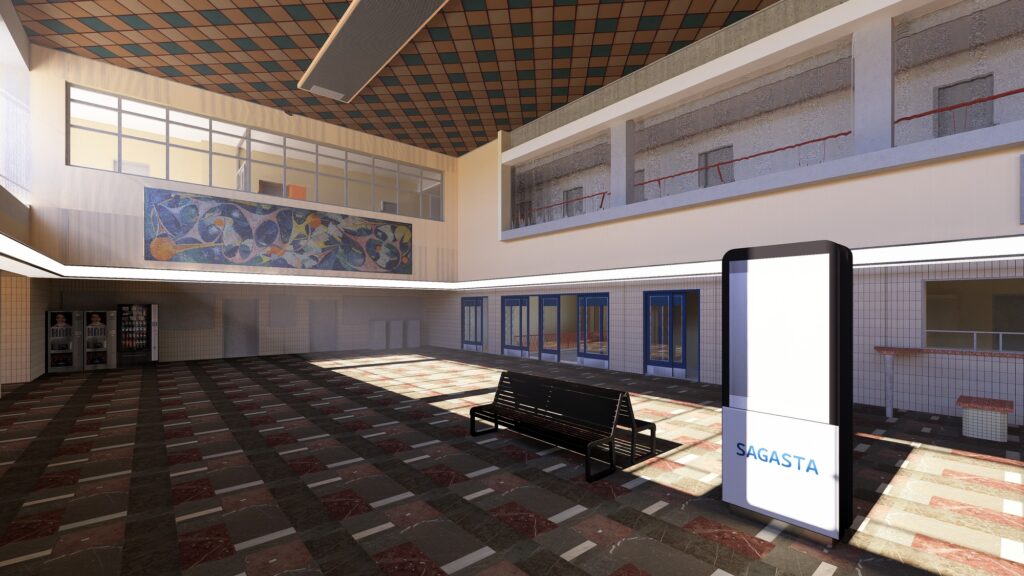
BIM is definitely not just about technology—we often work with historical objects or elements that don’t exist in any library, so we have to model them ourselves. We also do renovations of historical buildings. For example, in Cheb, we modeled stained glass windows, floors… It was great to go to the site, photograph the details, and put them into the model. I see this as an excellent combination of technology and art.
How do you perceive the current level of interest in BIM among students?
There is a general shortage of qualified people in the field of construction design, including those who know how to work with modern tools such as BIM. Of the twenty students in my class studying 3D design, only a few have remained in the field. At the same time, the need for people who know how to work with 3D data continues to grow.
From what you say, it is clear that someone in this field has quite a choice between companies. What led you to settle at Sagasta?
I first encountered the company during my school internship. I liked the structure of the company and its focus on public contracts, which I find interesting. We are involved in both transport construction and civil engineering. In addition, there is strong leadership here that is interested in developing people, and the environment is open to innovation. That was decisive for me. I started with classic design—I drew basic things for documentation. Gradually, I was given more complex tasks and became more involved in projects that utilized my experience with BIM. I began to focus on its implementation, training, and pure 3D modeling. I was happy to be able to bring some added value to the company.
What do you consider to be key for the profession of BIM coordinator?
Above all, a willingness to learn. Software is constantly evolving, and every job brings new challenges. If you like 3D environments and moving forward, you’ll find your place here. I see it as motivation—learning something new with every project. And that, in my opinion, is the biggest advantage.
How do you see the future of BIM?
BIM will inevitably become the standard in our industry in the coming decades. Public contracts already require 3D modeling as standard. Private contracts are gradually following suit.