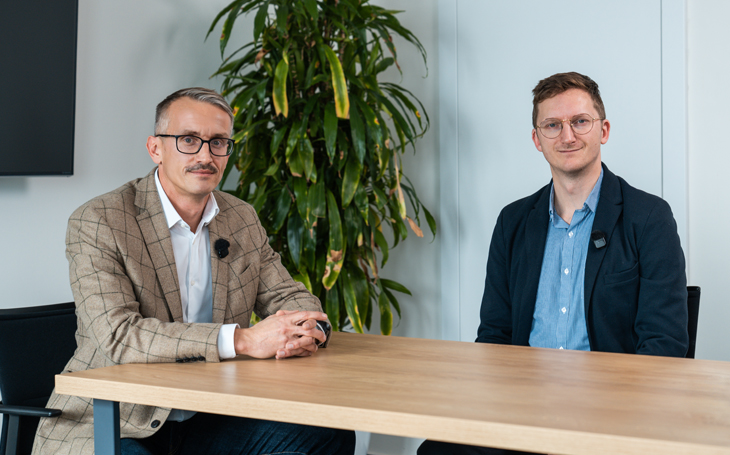
Vít Hoznour, co-founder of SAGASTA, oversees road, bridge and water management projects in the company. In an interview with RAILTARGET magazine, he spoke about the Pětidomí Tunnel, the highest bridge in the Czech Republic, high-speed rail, digitalisation and major transport infrastructure projects around the world.
According to Vít Hoznour, SAGASTA is a multidisciplinary company where projects overlap across individual studios. He cited bridge design as an example, explaining that his team also works on such projects in cooperation with colleagues from the railway infrastructure and above-ground and underground construction studios.
“We prepare all stages of project documentation – from technical and feasibility studies, through documentation for building permits and tender documentation, to detailed design documentation,” he explains, describing the broad scope of his team’s work. “We want our colleagues to have as comprehensive an approach to projects as possible and to experience the entire process – from the first line on paper all the way to construction,” he adds.
The Pětidomí Tunnel in České Budějovice Is a Major Challenge
Although the studio works on a wide range of projects, Hoznour highlights several major ones, including the Pětidomí Tunnel in České Budějovice. The multidisciplinary nature of the company is evident here as well. “Practically the entire SAGASTA team is working on Pětidomí, across departments and studios,” he says.
It is a highly complex project. “We are designing not only the tunnel itself, but also the connecting roads and bridge structures. The project also includes railway infrastructure, utility relocations and water management structures,” Hoznour explains. The complexity of the project is further underscored by the need to coordinate the requirements of two investors: the South Bohemian Region and the Railway Administration. “It is an exceptionally interesting project for us,” he concludes.
Ambitious Projects: High-Speed Rail and the Highest Bridge in the Czech Republic
The interview also touched on other major projects. One of them is the planned Plasy bypass in the Pilsen Region, which will include the construction of the highest bridge in the Czech Republic. “It is a demanding project, both in terms of coordination and because of the geotechnically challenging conditions in the deep valley of the Střela River,” Hoznour explains.
SAGASTA is also involved in the preparation of high-speed railway lines. “For example, we are working on the RS1 line, the Brodek u Přerova–Prosenice section, and RS5, the Náchod–state border section,” the director says. In his view, high-speed rail and projects related to the development of the motorway network will be of key importance in the future.
“We would also like to make further use of our experience with projects procured under the FIDIC Yellow Book, that is using the Design & Build method. For example, the I/36 Pardubice, Trnová–Fáblovka–Dubina road project is the largest FIDIC Yellow Book project in the Czech Republic. At the same time, we want to build on our experience with PPP projects, which we will undoubtedly see more of in the future,” he adds.
Modern Technologies and Education in the Construction Industry
The projects carried out by the studio and the company as a whole are linked by the use of modern materials and unconventional technologies. “In our designs, we often use high-performance concrete, for example. I would also mention our proposal to use geothermal energy in the Prague Metro Line D project. This is a unique solution in the Czech Republic, and the technology is used only rarely even elsewhere in the world. At the same time, it is highly efficient and environmentally friendly,” Hoznour adds.
SAGASTA is not only a participant in, but also a partner of, numerous conferences, which it sees as an important part of employee education and professional development. “Next year, for example, we are planning to attend the Road Conference, the Bridges Conference and KDI (the Transport Infrastructure Conference). I must also mention the Pardubice Railway event and the High-Speed Rail Conference. We will certainly also attend specialised conferences, such as the BIM Summit,” he says.
VPÚ DECO and SAGASTA: A Strong Partnership in Transport Projects
Last year, SAGASTA acquired a majority stake in VPÚ DECO, where Hoznour worked, with an interruption, as a lead designer from 1996 to 2014. According to him, the industry has changed fundamentally over nearly 30 years, as has the approach to design itself.
“I have only good memories of my time at VPÚ DECO. Even before we acquired our stake, we operated as friendly competitors and collaborated on some projects. The subsequent integration only strengthened the good relationship between the two companies,” Hoznour says, adding that VPÚ DECO has a rich history and extensive experience, particularly in the design of buildings – from civic and public buildings to healthcare and military facilities.
Digitalisation in Construction Has Accelerated Communication
Another important area that SAGASTA has been focusing on for a long time is digitalisation, whose development in public administration began to receive more intensive attention several years ago. “We started preparing for it before the COVID-19 pandemic. It was clear that this represented a fundamental change in the approach to design, and we wanted to be prepared,” Hoznour explains. In his view, public administration is currently lagging behind the private sector in digitalisation, particularly in BIM modelling.
“For us, BIM is part of our daily work today: we create a 3D model for every construction project. We want to continue developing in this area, for example by connecting the model with the scanning of structures during the construction phase, linking it to quantity take-offs and handing over as-built documentation.”
According to Hoznour, digitalisation has also significantly accelerated communication between designers, investors and contractors. “Today, an investor can view and comment on a digital model in real time. Contractors also use digital models during construction – for example, in construction machinery into which models of structures are uploaded. This is a major step forward compared with the days when documentation was handed over solely on paper.”
Shortage of Professionals in Construction and Technical Fields
The transformation has not only affected digitalisation but also the younger generation’s approach to education – technical fields are no longer as attractive as they once were. Hoznour therefore believes it is important to motivate young people from an early age, starting in primary school. “We need to show that design and construction in general have a far-reaching impact. We contribute to something modern and something with lasting value. The structures we work on are used by tens of thousands of people every day. And it is great to see a project you have contributed to in real life when travelling.”
He also highlights the benefits of working for SAGASTA: “We offer the opportunity to work on exceptionally large-scale projects, we have a modern and friendly working environment, and we place great emphasis on work-life balance.” He adds that the company also offers various forms of internships and temporary student jobs, with many students continuing to work for the company after completing their studies.
The World’s Most Interesting Transport Infrastructure Projects: The Alps, France and China
At the end of the interview, we asked Vít Hoznour which transport infrastructure projects abroad he admires. “The Swiss Alpine railway has some amazing bridge structures. I admire our predecessors who were able to build them with the technology available at the time – often within timeframes comparable to those we have today,” he says.
Among his other favourite structures is the Millau Viaduct in southern France – the highest bridge in Europe. “Of course, I would love to be involved in projects like these. And in a way, that dream is already coming true with the bridge at Plasy, which will also be an amazing structure.”
And what about projects outside Europe? Hoznour mentions, for example, the monumental transport infrastructure projects in China: “Their projects sometimes seem to us to come from another dimension – whether it is enormous urban interchanges or motorways built along riverbeds. In general, however, I am interested in every structure and its technical solution,” the director concludes.
Published on the RAILTARGET website with permission.